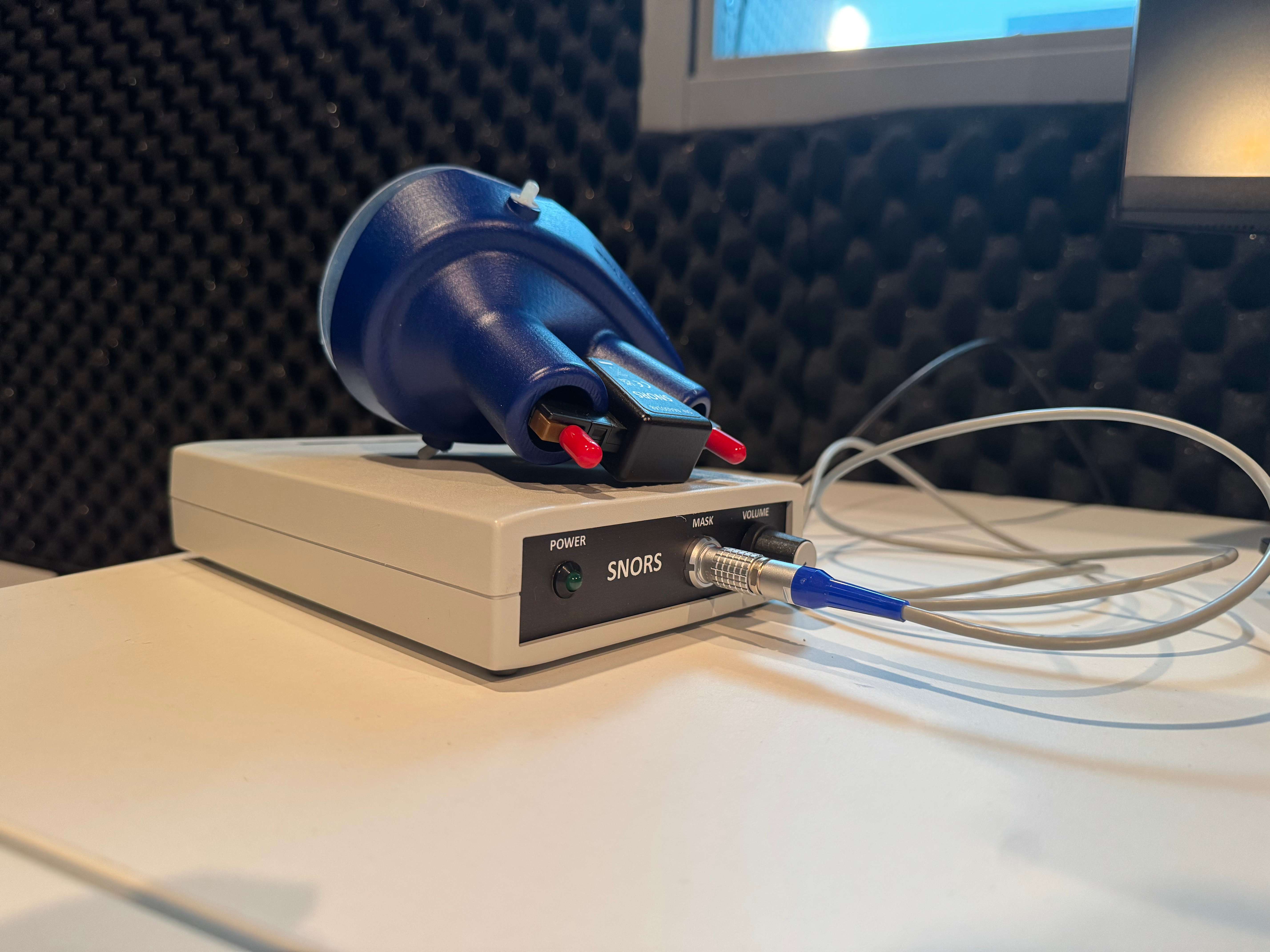
The Rose Medical Super Nasal-Oral Ratiometry System is a state-of-the-art device designed to measure and analyze the ratio of nasal to oral airflow during speech production. This technology has significant applications in both language teaching and linguistic research, making it an invaluable tool for universities and colleges focused on language and foreign language education.
The system operates through dual-channel airflow sensors, which simultaneously capture nasal and oral airflow with exceptional accuracy. This data is processed in real time, providing immediate visual feedback on airflow ratios. The system’s high-resolution data capture ensures that even subtle aspects of speech production can be analyzed. It is portable, user-friendly, and allows for the storage and export of data in multiple formats, making it suitable for both classroom instruction and advanced research.
In the context of language teaching, the device is particularly helpful for improving pronunciation. For example, nasalized vowels and consonants are crucial in languages such as French, Portuguese, and Hindi. Students often struggle to perceive and replicate these sounds accurately. The system allows instructors to provide objective, real-time feedback, helping students see and understand the balance of nasal and oral airflow required for proper pronunciation. This visual feedback accelerates learning by linking speech mechanics to audible results.
The system also supports groundbreaking research in phonetics and linguistics. It can be used to study cross-linguistic variations in nasalization, track how second language learners acquire nasalized sounds, and investigate speech disorders associated with improper airflow. Additionally, it is a valuable tool for examining regional dialectal variations in nasalization patterns, contributing to sociolinguistic and phonetic research.
By offering precise, detailed insights into speech production, the Rose Medical Super Nasal-Oral Ratiometry System enhances both the teaching of pronunciation and the understanding of linguistic phenomena. Its versatility, accuracy, and ease of use make it a critical investment for institutions seeking to advance their language education programs and foster innovation in linguistic research. Acquiring this system will ensure that the university remains at the forefront of language instruction and academic inquiry.