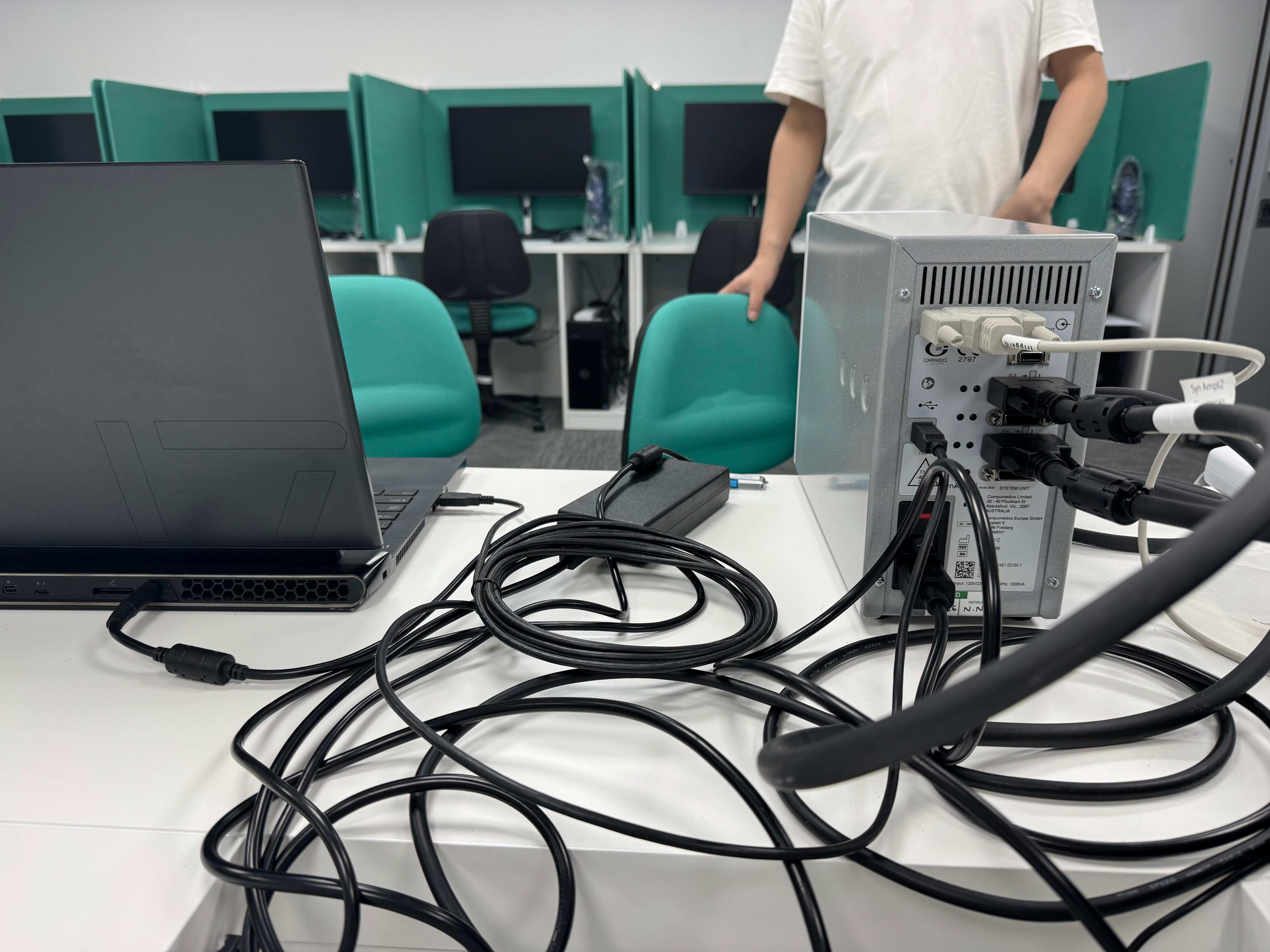
Event-Related Potential (ERP) recording systems are essential tools for studying the neural mechanisms underlying language processing. At our university college, where foreign language teaching and linguistic research are central, We aim to intergrate the NeuroScan SynAmps8050 amplifier, a 128-channel Quik-Cap, and NeuroScan Curry 8 software to enable groundbreaking research and teaching advancements.
The NeuroScan SynAmps8050 is a high-precision amplifier designed for capturing brain activity with exceptional sensitivity and minimal noise. It supports up to 256 channels, making it ideal for high-density EEG recordings. Paired with the 128-channel Quik-Cap, a comfortable and efficient electrode system, the device ensures accurate and detailed spatial resolution of brain signals. The NeuroScan Curry 8 software complements this setup by offering advanced signal processing, source localization, and neuroimaging integration, all through an intuitive interface that supports varied linguistic research paradigms.
This system measures the brain’s electrical responses to language tasks, such as processing foreign phonemes or producing speech sounds. These capabilities are transformative for both teaching and research. In pronunciation teaching, the system can identify specific phonemes that students struggle with and assess the impact of different instructional methods, providing measurable feedback and facilitating targeted interventions. For linguistic research, it reveals the timing and localization of neural activity during tasks like bilingual language switching, phoneme recognition, or intonation processing.
The ERP system is particularly valuable for studying how the brain adapts to language learning over time, offering insights into neuroplasticity and the efficacy of teaching methods. It also enables interdisciplinary research into topics such as age-related differences in language acquisition and the neural markers of successful learning.
By integrating this technology, our institution can refine language instruction, deepen understanding of the cognitive and neural basis of language learning, and foster innovative research. This system not only enhances teaching outcomes but would also positions our university college as a leader in the intersection of neuroscience, linguistics, and education.